
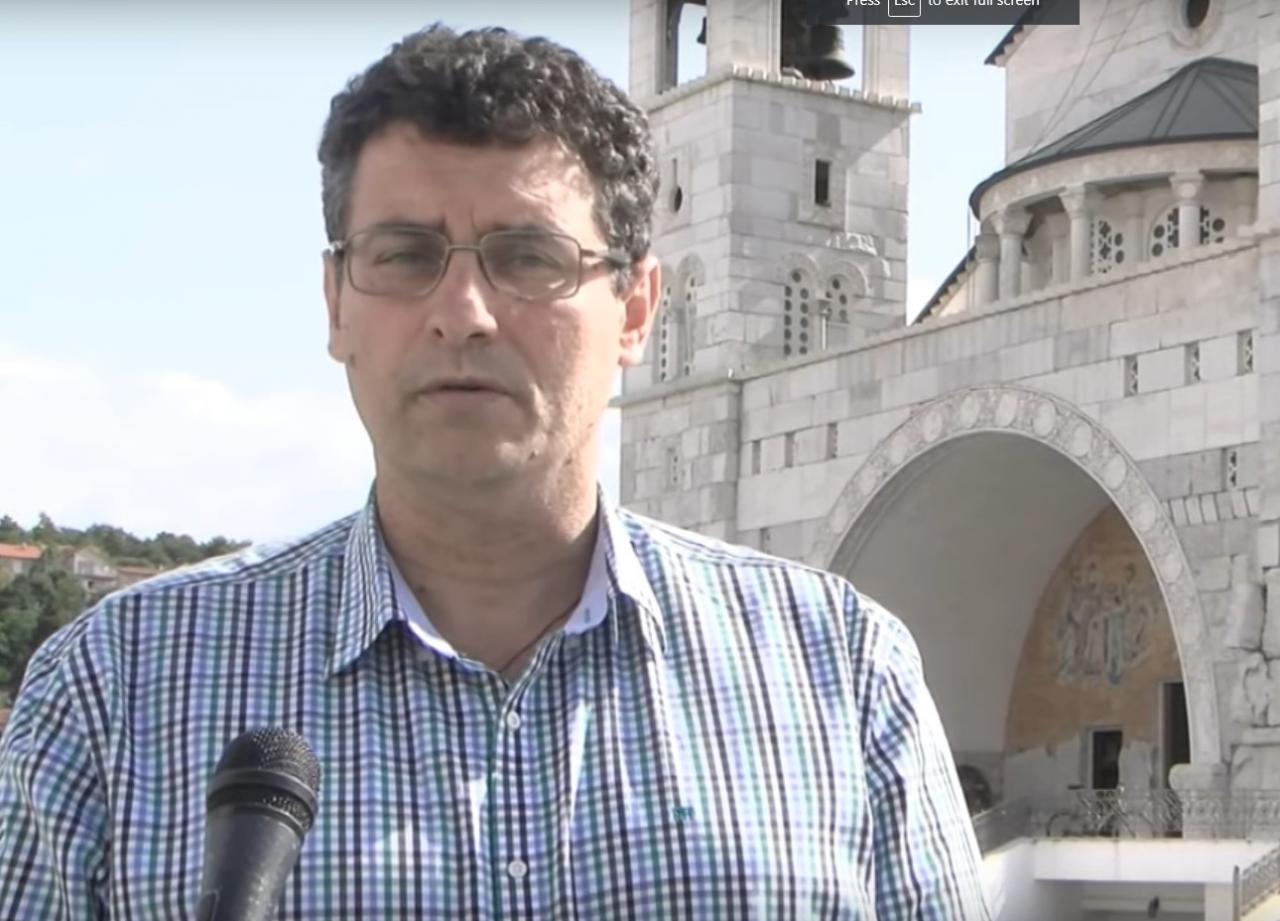
The NGO Pandurica from Nikšić, with the blessing and support of the Metropolitanate of Montenegro and the Littoral and the Diocese of Budimlje-Nikšić of the Serbian Orthodox Church, has for two years been carrying out a humanitarian and memorial initiative called “March Remembrance,” tied to two events from recent history: the “merciful” NATO bombing of 1999 that began in March, and the March pogrom of 2004.
I will write on another occasion about the importance of this initiative, its results, and why such NGO activities should be supported.
Of course, this is not the only memorial and humanitarian campaign being organized, but I believe that for the survival and progress of our people in Kosovo and Metohija, it is not enough. Unfortunately, the policy of those who are supposed to care about this hasn’t advanced much beyond a heifer. I’m not saying a heifer is a bad thing, but it’s certainly not enough. Let’s try to think of something beyond that framework.
The core issue of all small and provincial communities in the Balkans — and often beyond — is the lack of creative and productive jobs. In Kosovo and Metohija, the situation is even harder because everything often comes down to small trades, a bit of agriculture, and minor service jobs. That can hardly keep children and young people there. In addition to personal safety, people seek material security, but also challenges through which they can express their creative potential — so these business challenges need to be brought to their doorstep.
Therefore, it would be worthwhile to consider creating jobs that can be done remotely from Kosovska Mitrovica, other towns, and enclaves. The only jobs that could realistically be organized are in the form of remote work and some kind of outsourcing. There are quite a few such jobs on the hilly Balkans — particularly in programming, direct marketing, some forms of call centers, and more.
It’s true that this sector has been shaken recently, as everyone is waiting to see what artificial intelligence will take or bring, and outsourcing job offers have dropped by half in the last several months or year. Still, these jobs haven’t disappeared. In fact, AI might even generate some new opportunities…
To keep it short, we need four types of donors/contributors for a venture like this, which would combine business and humanitarian aspects:
• The first type: an individual or a company (ideally registered in the U.S., Canada, UK, etc.) who will found the company and secure its initial setup;
• The second type: since it’s unrealistic for such a company to be profitable in the first few years, we need an investor/wealthy individual/philanthropist who would cover its losses during that period (they could be domestic benefactors from Serbian regions — I suggest a three-year coverage period);
• The third type: someone to help train the employees;
• The fourth type: a competent lawyer to legally define the relationships among all entities (“clear accounts, long friendship”).
This isn’t something that can be realized in just a few weeks or months, but if you have people willing to participate, it could stand on its feet within a few years.
The goal is to start with one such venture and possibly grow to three over time (one at a time).
I wouldn’t object to the owner taking profit if there is any, nor to the second type of benefactor recovering some of their investment — if and when the company becomes sustainable. Again, I say: “clear accounts, long friendship,” and this must be framed legally with care.
The total cost for a year: 10–20 employees × salaries, company founding costs, basic equipment. In the following years, operational costs would decrease as the company earns revenue. I believe the second type of donor should cover losses for the first three years.
Altogether, 20 jobs in the creative sector per project wouldn’t exceed €1 million over three years, and I assume that with quality job inflow, at least half of that money would be returned even within those first years. If there were three projects, the cost should be multiplied accordingly — each with different donors. It’s not a small sum, but I believe (I hope) it’s not impossible. Compared to the “dead” real estate investments that have been made…
If there are multiple projects, they should ideally be geographically distributed (one in or around Kosovska Mitrovica, one in Metohija, and one in, say, Kosovo Pomoravlje). Naturally, this cannot happen overnight.
The University of Priština with temporary headquarters in Kosovska Mitrovica, which functions even during the current blockades and hardships faced by Serbs in Kosovo and Metohija, could serve as a pillar in educating and training youth from KiM — and not only from KiM — for such jobs.
Media coverage of these activities is of little help until some business actually gets off the ground. After that, “nothing succeeds like success.”
When you look at the total three-year investment, it’s a laughable amount for a state. Not to mention what could be done with some tax relief in Serbia for such activities. Still, perhaps it’s better to try doing this without any political interference.
No matter how unrealistic it may seem, I’m reminded of a statement by one of our (un)fortunate politicians: “one employed person means four votes.” And here, one employed young person = 4 young people stay in KiM (40 to 80 per project plus the multiplier effect and influence on other businesses).
Also, our people love to become independent, to start their own businesses once they feel capable — and this is the seed of exactly that future enterprise.
The field of peonies in Kosovo and Metohija could, in 10–15 years, become a Silicon Valley — or an e- or AI-valley — of Kosovo and Metohija.
“Nothing succeeds like success.”
Academician Igor Đurović